[YouTube] Building Antifragile Systems: Nassim Nicholas Taleb on Debt, AI, and the New Global Order

At Visa GCC Connect 2025, bestselling author of The Black Swan and Antifragile, Nassim Nicholas Taleb, issued a stark warning: the real fragilities aren’t hidden, they’re in plain sight. From soaring Western debt to AI disrupting white-collar professions, Taleb argues that global power is shifting back to the East, with China and Africa on the rise. His advice: systems cannot be engineered top-down. True resilience comes from entrepreneurs, risk-takers, and bottom-up innovation. Speaking at Visa GCC Connect 2025, Milan, Italy.

[Substack] Medical Mistakes with Probability, 2

Abstract: risk factors for LDL/ApoB underestimate the risk factor for Lp(a) positive subjects and overestimate for Lp(a) negative ones, a case of base-rate fallacy.

I am just using basic probabilistic logic here.

Risks factors for ASCVD from LDL (or ApoB) levels are computed for a general population which includes people with low and high Lp(a) levels. Now if having a high Lp(a) increases the cardiac risk over the baseline (up to 2-3 times!) and the proportion of subjects with high Lp(a) is between 15 and 28% of the population, then, necessarily, those with low Lp(a) will have, for a given level of LDL, a considerably lower risk and many might be treated unnecessarily.

The risk factor for nonLp(a) can be ~ 30% lower! Statins don’t come for free. There are hidden and less hidden side effects.

Continue reading on Substack – open.substack.com/pub/nntaleb/p/medical-mistakes-with-probability-284

[Substack] Medical Mistakes with Probability, 1

Max Heart Rate

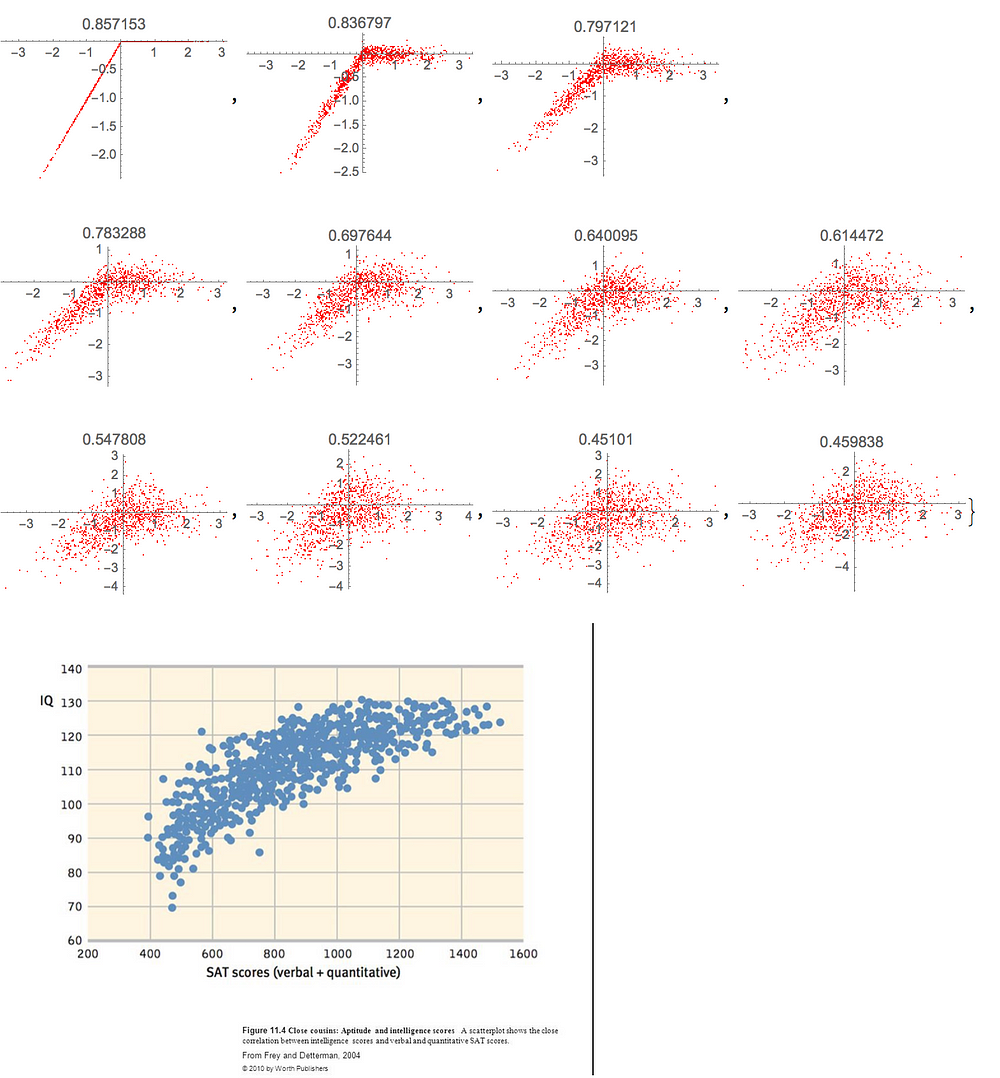
When you do a stress test, say the Bruce Protocol, the administering doctor relies on something called the “age predicted maximum heart rate”, usually 220 minus your age, or some formula slightly more complicated but equally unrigorous. Once you reach that point, they stop, depriving you of potent information — at low risk since they are monitoring via live ECG your cardiac strain. In fact, such an estimation based on age, no matter how complicated its computation, appears to explain only 20% of the variation between individuals. I believe that explained variations are even smaller for, clearly, in the graph above, to the right, samples above 55 are sparce and the expected maxima would be considerably higher.

I noticed this myself as I am easily able to reach the 170s without feeling strain, guessing the effective max would be in the 180s (next test, but would require some live ECG for caution).

Continue reading on Substack – open.substack.com/pub/nntaleb/p/medical-mistakes-with-probability

[X] Year in Review 2024

Paper: Anatolian genetic ancestry in North Lebanese populations

Lebanon’s rich history as a cultural crossroad spanning millennia has significantly impacted the genetic composition of its population through successive waves of migration and conquests from surrounding regions. Within modern-day Lebanon, the Koura district stands out with its unique cultural foundations, primarily characterized by a notably high concentration of Greek Orthodox Christians compared to the rest of the country. This study investigates whether the prevalence of Greek Orthodoxy in Koura can be attributed to modern Greek heritage or continuous blending resulting from the ongoing influx of refugees and trade interactions with Greece and Anatolia. We analyzed both ancient and modern DNA data from various populations in the region which could have played a role in shaping the current population of Koura using our own and published data. Our findings indicate that the genetic influence stemming directly from modern Greek immigration into the area appears to be limited. While the historical presence of Greek colonies has left its mark on the region’s past, the distinctive character of Koura seems to have been primarily shaped by cultural and political factors, displaying a stronger genetic connection mostly with Anatolia, with affinity to ancient but not modern Greeks.

Link to paper – www.nature.com/articles/s41598-024-66191-x.epdf

[Upcoming] A Conversation with Nassim Nicholas Taleb (2024)

A Conversation with Nassim Nicholas Taleb 2024

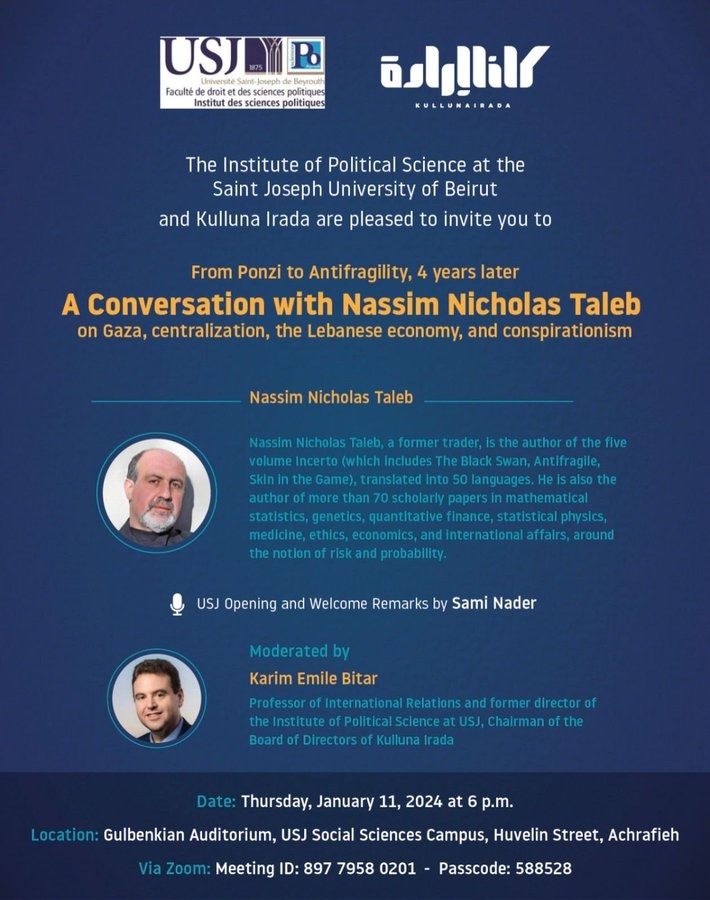
Event Invitation: A Conversation with Nassim Nicholas Taleb

Hosted by: The Institute of Political Science at the Saint Joseph University of Beirut and Kulluna Irada

Event Title: From Ponzi to Antifragility, 4 Years Later

Featuring: Nassim Nicholas Taleb

Topics: Gaza, Centralization, the Lebanese Economy, and Conspirationism

Moderator: Karim Emile Bitar

Date and Time: Thursday, January 11, 2024, at 6 PM

Location: Gulbenkian Auditorium, USJ Social Sciences Campus, Huvelin Street, Achrafieh

Virtual Attendance via Zoom:

  • Meeting ID: 897 7958 0201
  • Passcode: 588528

Join us for an insightful evening with Nassim Nicholas Taleb, discussing critical contemporary issues in a conversation moderated by Karim Emile Bitar.

[The Guardian] The UK’s coronavirus policy may sound scientific. It isn’t

Nassim Nicholas Taleb and Yaneer Bar-Yam

When, along with applied systems scientist Dr Joe Norman, we first reacted to coronavirus on 25 January with the publication of an academic note urging caution, the virus had reportedly infected fewer than 2,000 people worldwide and fewer than 60 people were dead. That number need not have been so high.

Link: https://www.theguardian.com/commentisfree/2020/mar/25/…cummings