On Medium, Nassim posts an excerpt from Skin in the Game:
What we have been seeing worldwide, from India to the UK to the US, is the rebellion against the inner circle of no-skin-in-the-game policymaking “clerks” and journalists-insiders, that class of paternalistic semi-intellectual experts with some Ivy league, Oxford-Cambridge, or similar label-driven education who are telling the rest of us 1) what to do, 2) what to eat, 3) how to speak, 4) how to think… and 5) who to vote for.
But the problem is the one-eyed following the blind: these self-described members of the “intelligenzia” can’t find a coconut in Coconut Island, meaning they aren’t intelligent enough to define intelligence hence fall into circularities — but their main skill is capacity to pass exams written by people like them. With psychology papers replicating less than 40%, dietary advice reversing after 30 years of fatphobia, macroeconomic analysis working worse than astrology, the appointment of Bernanke who was less than clueless of the risks, and pharmaceutical trials replicating at best only 1/3 of the time, people are perfectly entitled to rely on their own ancestral instinct and listen to their grandmothers (or Montaigne and such filtered classical knowledge) with a better track record than these policymaking goons.
Indeed one can see that these academico-bureaucrats who feel entitled to run our lives aren’t even rigorous, whether in medical statistics or policymaking. They cant tell science from scientism — in fact in their eyes scientism looks more scientific than real science. (For instance it is trivial to show the following: much of what the Cass-Sunstein-Richard Thaler types — those who want to “nudge” us into some behavior — much of what they would classify as “rational” or “irrational” (or some such categories indicating deviation from a desired or prescribed protocol) comes from their misunderstanding of probability theory and cosmetic use of first-order models.) They are also prone to mistake the ensemble for the linear aggregation of its components as we saw in the chapter extending the minority rule.
The Intellectual Yet Idiot is a production of modernity hence has been accelerating since the mid twentieth century, to reach its local supremum today, along with the broad category of people without skin-in-the-game who have been invading many walks of life. Why? Simply, in most countries, the government’s role is between five and ten times what it was a century ago (expressed in percentage of GDP). The IYI seems ubiquitous in our lives but is still a small minority and is rarely seen outside specialized outlets, think tanks, the media, and universities — most people have proper jobs and there are not many openings for the IYI.
Beware the semi-erudite who thinks he is an erudite. He fails to naturally detect sophistry.
The IYI pathologizes others for doing things he doesn’t understand without ever realizing it is his understanding that may be limited. He thinks people should act according to their best interests and he knows their interests, particularly if they are “red necks” or English non-crisp-vowel class who voted for Brexit. When plebeians do something that makes sense to them, but not to him, the IYI uses the term “uneducated”. What we generally call participation in the political process, he calls by two distinct designations: “democracy” when it fits the IYI, and “populism” when the plebeians dare voting in a way that contradicts his preferences. While rich people believe in one tax dollar one vote, more humanistic ones in one man one vote, Monsanto in one lobbyist one vote, the IYI believes in one Ivy League degree one-vote, with some equivalence for foreign elite schools and PhDs as these are needed in the club.
More socially, the IYI subscribes to The New Yorker. He never curses on twitter. He speaks of “equality of races” and “economic equality” but never went out drinking with a minority cab driver (again, no real skin in the game as the concept is foreign to the IYI). Those in the U.K. have been taken for a ride by Tony Blair. The modern IYI has attended more than one TEDx talks in person or watched more than two TED talks on Youtube. Not only will he vote for Hillary Monsanto-Malmaison because she seems electable and some such circular reasoning, but holds that anyone who doesn’t do so is mentally ill.
The IYI has a copy of the first hardback edition of The Black Swan on his shelves, but mistakes absence of evidence for evidence of absence. He believes that GMOs are “science”, that the “technology” is not different from conventional breeding as a result of his readiness to confuse science with scientism.
Typically, the IYI get the first order logic right, but not second-order (or higher) effects making him totally incompetent in complex domains. In the comfort of his suburban home with 2-car garage, he advocated the “removal” of Gadhafi because he was “a dictator”, not realizing that removals have consequences (recall that he has no skin in the game and doesn’t pay for results).
The IYI has been wrong, historically, on Stalinism, Maoism, GMOs, Iraq, Libya, Syria, lobotomies, urban planning, low carbohydrate diets, gym machines, behaviorism, transfats, freudianism, portfolio theory, linear regression, Gaussianism, Salafism, dynamic stochastic equilibrium modeling, housing projects, selfish gene, Bernie Madoff (pre-blowup) and p-values. But he is convinced that his current position is right.
The IYI is member of a club to get traveling privileges; if social scientist he uses statistics without knowing how they are derived (like Steven Pinker and psycholophasters in general); when in the UK, he goes to literary festivals; he drinks red wine with steak (never white); he used to believe that fat was harmful and has now completely reversed; he takes statins because his doctor told him to do so; he fails to understand ergodicity and when explained to him, he forgets about it soon later; he doesn’t use Yiddish words even when talking business; he studies grammar before speaking a language; he has a cousin who worked with someone who knows the Queen; he has never read Frederic Dard, Libanius Antiochus, Michael Oakeshot, John Gray, Amianus Marcellinus, Ibn Battuta, Saadiah Gaon, or Joseph De Maistre; he has never gotten drunk with Russians; he never drank to the point when one starts breaking glasses (or, preferably, chairs); he doesn’t even know the difference between Hecate and Hecuba (which in Brooklynese is “can’t tell sh**t from chinola”); he doesn’t know that there is no difference between “pseudointellectual” and “intellectual” in the absence of skin in the game; has mentioned quantum mechanics at least twice in the past five years in conversations that had nothing to do with physics.
He knows at any point in time what his words or actions are doing to his reputation.
But a much easier marker: he doesn’t even deadlift.
Nassim shares an excerpt from his work-in-progess Skin in the Game, at Evonomics. In a fascinating article called How To Legally Own Another Person, he discusses how and why well-paid employees behave much like slaves. It begins:
In its early phase, as the church was starting to get established in Europe, there was a group of itinerant people called the gyrovagues. They were gyrating and roaming monks without any affiliation to any institution. Theirs was a free-lance (and ambulatory) variety of monasticism, and their order was sustainable as the members lived off begging and from the good graces of townsmen who took interest in them. It is a weak form of sustainability, as one can hardly call sustainable a group of a people with vows of celibacy: they cannot grow organically and would need continuous enrollment. But their members managed to survive thanks to help from the population, which provided them with food and temporary shelter.
Sometimes around the fifth century, they started disappearing –they are now extinct. The gyrovagues were unpopular with the church, banned by the council of Chalcedon in the Fifth Century, then again by the second council of Nicaea about three hundred years later. In the West, Saint Benedict of Nurcia, their greatest detractor, favored a more institutional brand of monasticism and ended up prevailing with his rules that codified the activity, with a hierarchy and strong supervision by an abbot. For instance, Benedict’s rulesiii, put together in a sort of instruction manual, stipulate that a monk’s possessions should be in the hands of the abbot (Rule 33) and Rule 70 bans angry monks from hitting other monks.
Why were they banned? They were, simply, totally free. They were financially free, and secure, not because of their means but because of their wants. Ironically by being beggars, they had the equivalent of f*** you money, the one can get more easily by being at the lowest rung than by being member of the income dependent class.
The Skin In The Game Heuristic for Protection Against Tail Events
Constantine Sandis
Oxford Brooks
Nassim Nicholas Taleb
NYU-Poly; Université Paris I Panthéon-Sorbonne – Centre d’Economie de la Sorbonne (CES)
July 30, 2013
Abstract:
Standard economic theory makes an allowance for the agency problem, but not the compounding of moral hazard in the presence of informational opacity, particularly in what concerns high-impact events in fat tailed domains. But the ancients did; so did many aspects of moral philosophy. We propose a global and morally mandatory heuristic that anyone involved in an action which can possibly generate harm for others, even probabilistically, should be required to be exposed to some damage, regardless of context. While perhaps not sufficient, the heuristic is certainly necessary hence mandatory. It is supposed to counter risk hiding and transfer in the tails. We link the rule to various philosophical approaches to ethics and moral luck.
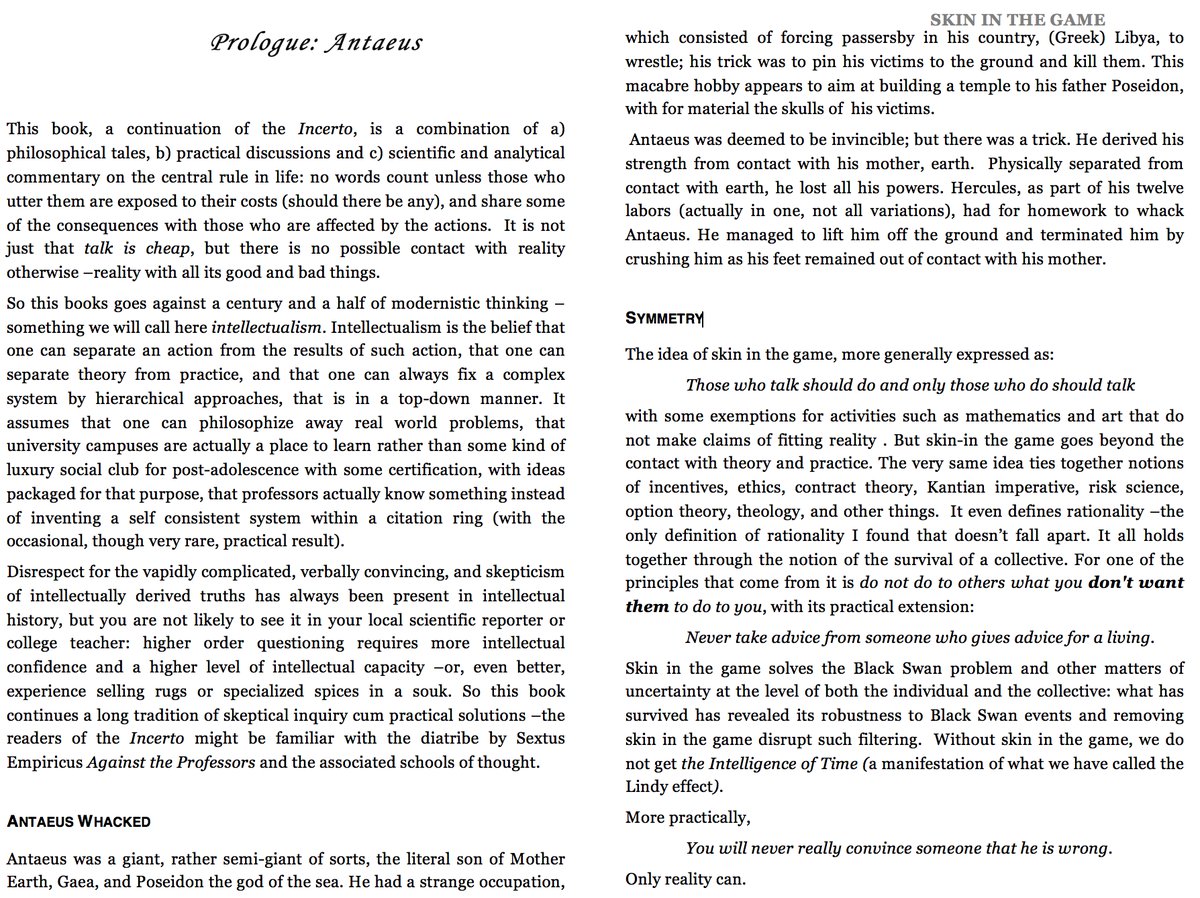
Nassim Taleb of NYU-Poly talks with EconTalk host Russ Roberts about his recent paper (with Constantine Sandis) on the morality and effectiveness of “skin in the game.” When decision makers have skin in the game–when they share in the costs and benefits of their decisions that might affect others–they are more likely to make prudent decisions than in cases where decision-makers can impose costs on others. Taleb sees skin in the game as not just a useful policy concept but a moral imperative. The conversation closes with some observations on the power of expected value for evaluating predictions along with Taleb’s thoughts on economists who rarely have skin in the game when they make forecasts or take policy positions.
Nassim Taleb of NYU-Poly talks with EconTalk host Russ Roberts about his recent paper (with Constantine Sandis) on the morality and effectiveness of “skin in the game.” When decision makers have skin in the game–when they share in the costs and benefits of their decisions that might affect others–they are more likely to make prudent decisions than in cases where decision-makers can impose costs on others. Taleb sees skin in the game as not just a useful policy concept but a moral imperative. The conversation closes with some observations on the power of expected value for evaluating predictions along with Taleb’s thoughts on economists who rarely have skin in the game when they make forecasts or take policy positions.