[Substack] Medical Mistakes with Probability, 1

Max Heart Rate

When you do a stress test, say the Bruce Protocol, the administering doctor relies on something called the “age predicted maximum heart rate”, usually 220 minus your age, or some formula slightly more complicated but equally unrigorous. Once you reach that point, they stop, depriving you of potent information — at low risk since they are monitoring via live ECG your cardiac strain. In fact, such an estimation based on age, no matter how complicated its computation, appears to explain only 20% of the variation between individuals. I believe that explained variations are even smaller for, clearly, in the graph above, to the right, samples above 55 are sparce and the expected maxima would be considerably higher.

I noticed this myself as I am easily able to reach the 170s without feeling strain, guessing the effective max would be in the 180s (next test, but would require some live ECG for caution).

Continue reading on Substack – open.substack.com/pub/nntaleb/p/medical-mistakes-with-probability

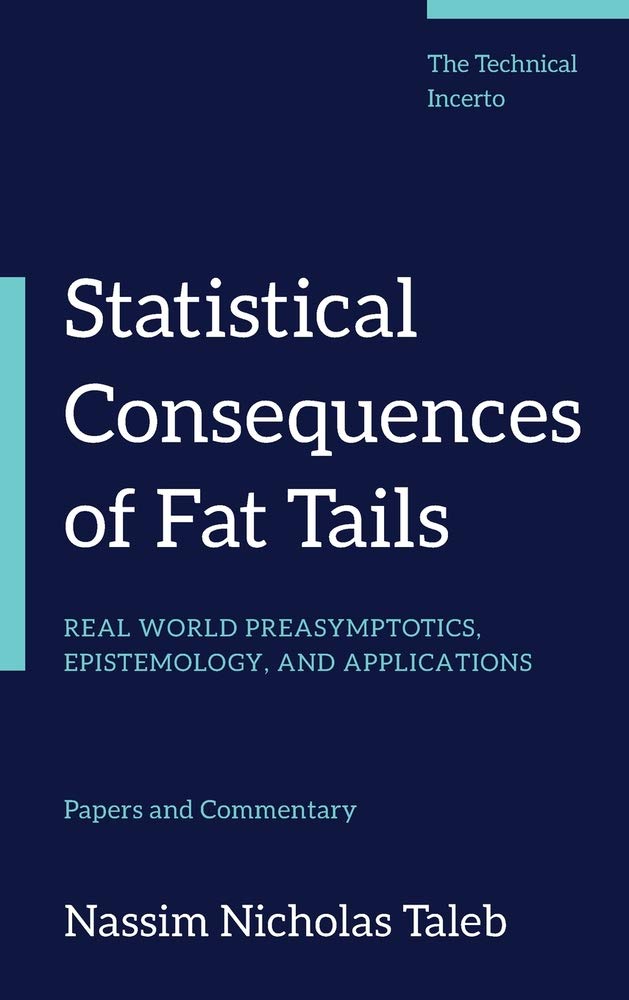
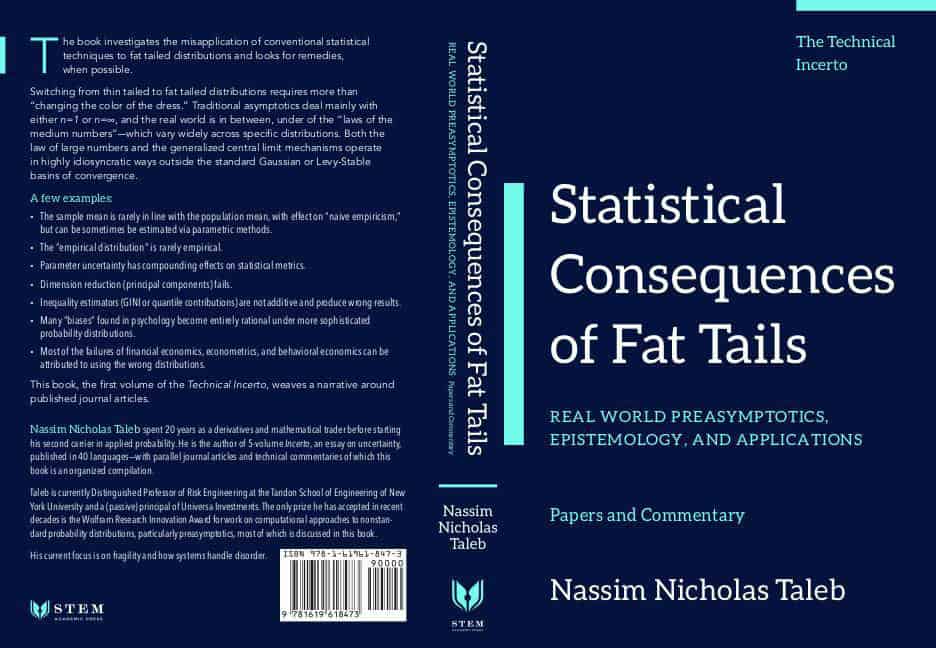
The book Statistical Consequences of Fat Tails: Real World Preasymptotics, Epistemology, and Applications is finally on Amazon

Cover of Nassim's book

The book Statistical Consequences of Fat Tails: Real World Preasymptotics, Epistemology, and Applications is finally on Amazon. Click Here.

PDF freely available here – Nassim Nicholas Taleb (2020). Statistical Consequences of Fat Tails: Real World Preasymptotics, Epistemology, and Applications. RESEARCHERS.ONE, https://www.researchers.one/article/2020-01-21.

Technical Incerto, Vol 1: The Statistical Consequences of Fat Tails

From Nassim Taleb’s Facebook Page:

My Technical Incerto Vol1: The Statistical Consequences of Fat Tails is almost done. This is the freely available draft for error correction.

https://www. academia. edu/ 37221402/ TECHNICAL…

Link to Paper: https://www. academia. edu/ 37221402/ TECHNICAL…
Link to Facebook Discussion: https://www. facebook. com/ nntaleb/ posts/ 10156061900203375