In this Bloomberg Odd Lots podcast episode, hosts Joe Weisenthal and Tracy Alloway have a wide-ranging conversation with Nassim Taleb, well-known author of Antifragile, The Black Swan, and Fooled by Randomness. Taleb has been engaging in public debates on Twitter with various communities such as Bitcoiners, anti-vaxxers, venture capitalists, and deadlifters. The discussion covers topics such as Taleb’s clash with these communities and what they’re getting wrong about his ideas, as well as his newfound passion for cycling and how to reduce tail risk in one’s own life. Join us for this engaging conversation on finance, economics, and markets.
Tag: Antifragility
Working With Convex Responses: Antifragility From Finance to Oncology
Link to article – www.mdpi.com/1099-4300/25/2/343
[YouTube] First Course on Fragility, Convexity, and Antifragility (Nontechnical)
A first, very introductory presentation of fragility as linked to both nonlinearity and dislike of variations. Antifragility is almost the opposite, limited to a specific range of variations.
Explains:
- Why everything fragile must be concave.
- The medical S curve.
- Why harm to the climate is necessarily nonlinear in dose response.
- How hospitals can be overcrowded unless there are redundancies.
Further discussions will be more technical.
[YouTube] enlightED 2020: Conversation between Nassim Taleb and Teresa Martín-Retortillo
Conversation between Nassim Nicholas Taleb and Executive President of IE Exponential Learning at IE University, Teresa Martín-Retortillo at enlightED Virtual Edition 2020.
starts at 12:45 of the YouTube video.
[Medium] Lebanon: from Ponzi to Antifragility

About two years before the recent collapse, at a dinner, a then (slow thinking) member of the Lebanese parliament kept bugging me for an economic forecast. There was already some anxiety in the air. My answer was that we were facing imminent financial disaster, but that it was not necessarily bad news, long term. Why? Because such a total collapse could lead to natural responses that are better than the one we would have spontaneously, going from patching bad stuff to patching worse stuff. The lira was artificially kept too strong for any industry to survive and the financial system (the Ponzi) was sucking up all the money and destroying the economic substructure. But my point was that the (unavoidable) collapse would lead to an adaptation, the weaning from chronic foreign “loans” and, possibly, a huge bounce. De-financializing the country was a necessity, and people never do that spontaneously. Nothing was going to be fixed without a collapse. Was I optimistic? pessimistic? He was trying to figure out what I was saying and couldn’t get it as it did not fit his elementary static classification.
Continue reading on Medium: medium.com/@nntaleb/lebanon-from-ponzi-to-antifragility
What to expect from the 2020s: the world’s big thinkers make their predictions
Link to full article: Thetimes.co.uk
Medium Post: An Expert Called Lindy
(Background. The Black Swan explains the domain-dependence of expertise: why the electrician, dentist, are experts, while the journalist, State Department bureaucrat, and macroeconomist are not. Since then, there has been a global movement against the pseudo-expert, the serial incompetence of a certain class of babbling and pompous operatives across bureaucrato-academic professions. Which leads to the question: who is the real expert? Who decides on who is and who is not expert? Where is the metaexpert? Time it is. Or, rather, Lindy.)
Lindy is a deli in New York, now a tourist trap, that proudly claims to be famous for its cheesecake, but in fact has been known for the fifty or so years of interpretation by physicists and mathematicians of the heuristic that developed there. Actors who hung out there gossiping about other actors discovered that Broadway shows that lasted, say one hundred days, had a future life expectancy of a hundred more. For those that lasted two hundred days, two hundred more. The heuristic became known as the Lindy Effect.
Click through to read the rest of the post on Medium.
Nassim Presents First Medical Paper on Antifragility
Nassim will present his first medical paper on antifragility on Monday, November 28 at the University of Pennsylvania School of Medicine. On Facebook, Nassim says that this is “basically, a more technical version of the book Antifragile.” He also adds “Note that this is not making any standalone empirical point, rather gluing various phenomena under the convexity argument, with necessary connections (if… then necessarily).”
Now Available: The Incerto Box Set
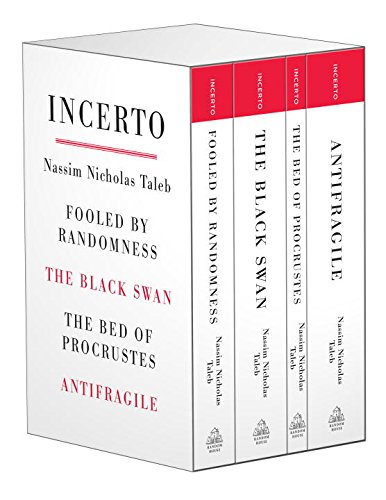
The Incerto, which comprises Fooled by Randomness, The Black Swan, The Bed of Procrustes, and Antifragile, is now available on Amazon as a box set.
Nassim to Visit Moscow and Kiev
The brokerage firm Alpari sponsors two seminars featuring Nassim, titled “Black Swan: predicting and winning in a world of chaos”, that will take place in Kiev, Ukraine on October 10th, and in Moscow on the 12th.